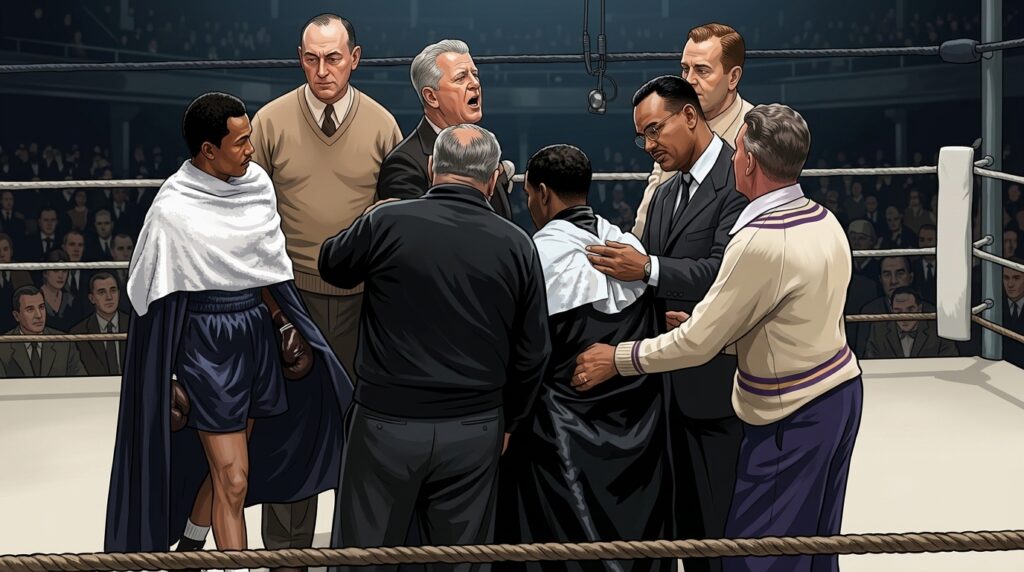
Henry Armstrong secured a decisive 10-round points victory over Baby Arizmendi at Wrigley Field in Los Angeles to win the California Mexican World Featherweight Title, avenging two prior losses and establishing his position as a major championship contender.
Fighting before a crowd of more than 16,000 spectators, Armstrong established control through sustained pressure and unrelenting volume inside the ring. The American contender, nicknamed “Homicide Hank”, threw punch combinations from all angles, depriving the defending champion of space to settle. Arizmendi had previously defeated Armstrong via decisions in Mexico City in November 1934 and in Los Angeles two months later. However, this third meeting proved entirely one-sided. From the opening bell, Armstrong forced a grueling pace that kept Arizmendi on the defensive. Although Armstrong never registered a knockdown, contemporary newspaper accounts described the fight as one of the most punishing defeats of Arizmendi’s career. The Mexican fighter relied on sheer determination to withstand heavy punishment and endure to the final bell despite reaching near-exhaustion across several rounds.
The official decision awarded Armstrong the California Mexican World Featherweight Title, recognized by the California State Athletic Commission as the primary championship in its jurisdiction.
Beyond securing the title and a $2,000 purse, the performance fundamentally altered Armstrong’s professional trajectory. Sitting at ringside, reigning universal world featherweight champion Petey Sarron witnessed the display firsthand. Less than a year later, Armstrong stopped Sarron to capture the undisputed featherweight title. The victory also attracted entertainer Al Jolson, who subsequently aided in buying out Armstrong’s promotional contract to facilitate higher-profile bouts. This outcome set the stage for Armstrong’s historic expansion across divisions, where he eventually became the first boxer to hold world championships at featherweight, lightweight, and welterweight simultaneously. Arizmendi, by contrast, required several months away from boxing to recover from the physical damage sustained over the ten rounds.