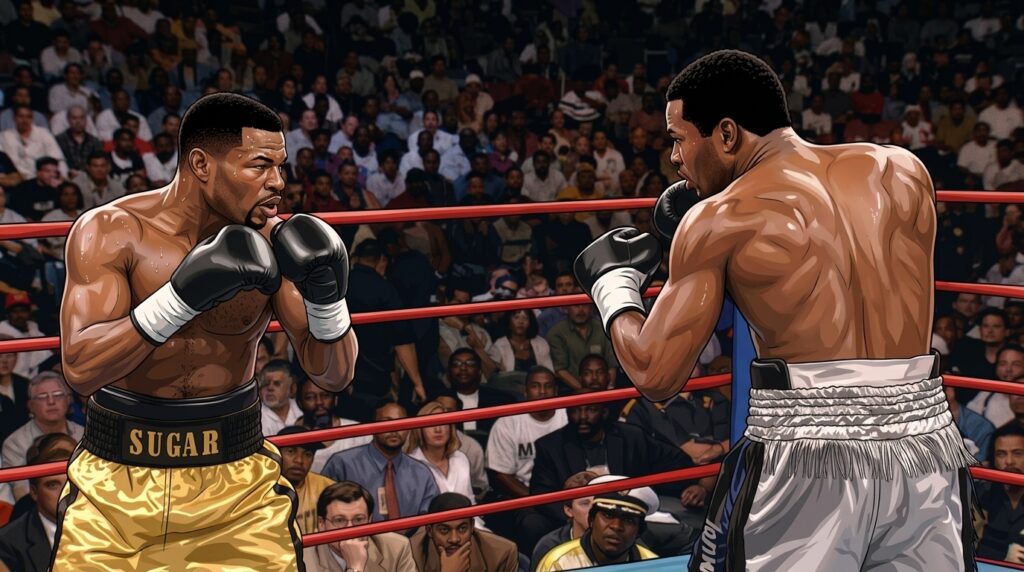
Vernon Forrest proved his first victory was no fluke by defeating Shane Mosley for a second consecutive time on July 20, 2002. Forrest used his size and jab to win a unanimous decision, defending his WBC welterweight title and silencing all doubt.
The rematch, held at Conseco Fieldhouse in Indianapolis, carried significant weight. Six months after upsetting Mosley to win the championship, Forrest had to prove the win was earned, not lucky. Mosley, in turn, was expected to make adjustments and reclaim his status. The event drew a record Indiana boxing crowd of 15,775, with both fighters earning career-high paydays.
From the opening bell, the tactical clash was clear. Mosley came out with aggression, determined to force a brawl. But Forrest refused to engage on Mosley’s terms. Standing three inches taller and possessing a longer reach, Forrest established his jab immediately. He circled the ring, fired sharp counters against Mosley’s advances, and strategically tied him up in clinches whenever the distance closed. This pattern frustrated Mosley, forcing him to constantly reset his offense.
The middle rounds became a grinding, physical affair. Forrest consistently landed his jab and smothered Mosley’s inside work, leading referee Laurence Cole to separate the fighters repeatedly. The lack of sustained exchanges drew some boos, but Forrest never deviated from his game plan. His discipline was absolute.
Mosley mounted a final push in the championship rounds, leading to spirited action in the tenth. Still, Forrest met the pressure with crisp counterpunching and landed several hard right hands in the eleventh before boxing his way through the final round. Though there were no knockdowns, Forrest landed the cleaner and more effective punches throughout. CompuBox statistics showed Forrest landed 120 punches to Mosley’s 114, with his ring control and timing making the difference.
The judges’ scorecards confirmed what observers saw, ruling in favor of Forrest 117-111, 116-112, and 115-113. The victory closed the book on their rivalry, which began when Forrest also defeated Mosley in the 1992 U.S. Olympic Trials. The win remains a signature moment in Forrest’s Hall of Fame career, a masterful performance that cemented his legacy.