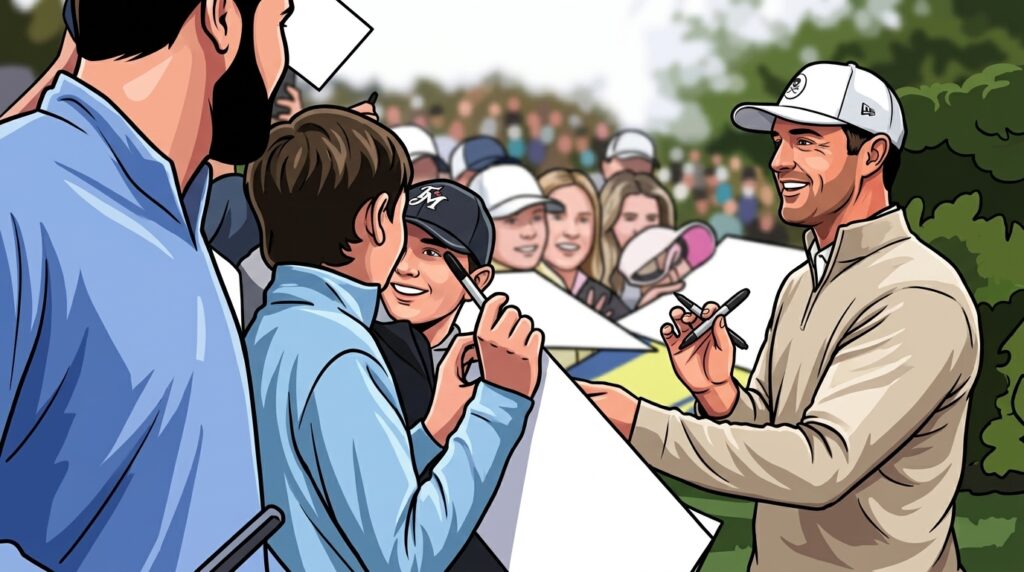
Eleven LIV Golf members have secured entry into the 2026 PGA Championship. Jon Rahm and Bryson DeChambeau headline the breakaway circuit’s representation at Quail Hollow this week. Their inclusion intensifies the lingering divide between the tours during the season’s second major.
The presence of eleven players from the Saudi-backed circuit at Quail Hollow underscores a fractured era in professional golf. Major championships remain the sole arenas where statistical parity can be established without caveats. For players operating completely outside the traditional Official World Golf Ranking apparatus, these four weeks validate their current competitive form against the broader establishment. Rahm and DeChambeau arrive as the most mathematically sound contenders from the breakaway roster, carrying the burden of proof for their entire league. Quail Hollow is an unrelenting test of long-iron ball-striking, historically rewarding those who dominate SG: Off-the-Tee and SG: Approach. Driving accuracy operates as a secondary metric here compared to pure carry distance, a structural reality that heavily favors DeChambeau’s aggressive course management and high ball speeds.
DeChambeau’s reliance on overwhelming swing speed fundamentally changes the geometry of the longer par-fours, allowing him to bypass the most penal fairway bunkers. He consistently forces wedges and short irons into heavily guarded greens, neutralizing the course’s primary defenses. Rahm operates with a different methodology. The Spaniard relies on elite scrambling percentages and a remarkably high bounce-back rate to maintain momentum during difficult scoring stretches. His ability to control trajectory with mid-irons, manipulating spin rates into tiered greens, makes him uniquely suited for the firm conditions expected in mid-May. Both men demand perfection in their SG: Putting metrics to convert these tactical advantages into a lead.
The broader sentiment regarding ranking points and major qualification among the breakaway roster remains thoroughly indifferent. The prevailing attitude is sharply crystallized by recent media dispatches tracking the circuit’s fringe figures, highlighted by the explicit declaration, “‘I don’t give a sh–’: Defiant Anthony Kim reaches surprising ranking milestone” when discussing his own isolated standing. The elite LIV players share this exact apathy toward traditional metrics, viewing the OWGR as an obsolete measurement of their capabilities. Their focus is entirely restricted to major championship execution and the immediate returns of peak performance.
But major championship pressure cannot be simulated in 54-hole, no-cut exhibitions.
The statistical models attempting to cross-reference LIV form with PGA Tour data rely heavily on SG: Total and raw birdie conversion rates, yet these numbers lack the friction of a Friday afternoon cut line. This gap in competitive conditioning frequently exposes the lower half of the LIV contingent over 72 grueling holes. The eleven players in the field face a brutal physical and mental examination that cannot be replicated on their home circuit. Quail Hollow demands strict discipline regarding GIR and proximity to the hole. Missing on the short side yields a scrambling percentage well below the tour average, heavily penalizing any player lacking elite SG: Around-the-Green capabilities.
The consequences of this week extend far beyond the immediate acquisition of the Wanamaker Trophy. The 2026 Ryder Cup selection arguments for both sides are completely live, and performances at Quail Hollow will heavily influence the upcoming roster construction. Captains on both the United States and European sides are actively evaluating whether these isolated stars possess the necessary sharpness for intense team competition. Rahm requires a commanding performance to guarantee his selection without relying heavily on a subjective captain’s pick. DeChambeau finds himself in an identical position, needing to prove that his raw power translates into major championship resilience under standard tour conditions.
A victory by any of the eleven LIV representatives forces a massive recalculation of the professional hierarchy. If Rahm or DeChambeau secures the title, it validates the competitive integrity of their isolated schedule and forces the establishment to acknowledge their sustained dominance. Conversely, a collective failure by the breakaway contingent will accelerate criticisms regarding their lack of 72-hole endurance and competitive edge. The tension at Quail Hollow is entirely structural. The PGA Championship operates as the ultimate proving ground for a divided sport, and these eleven players carry the full weight of their circuit’s credibility into the opening round.