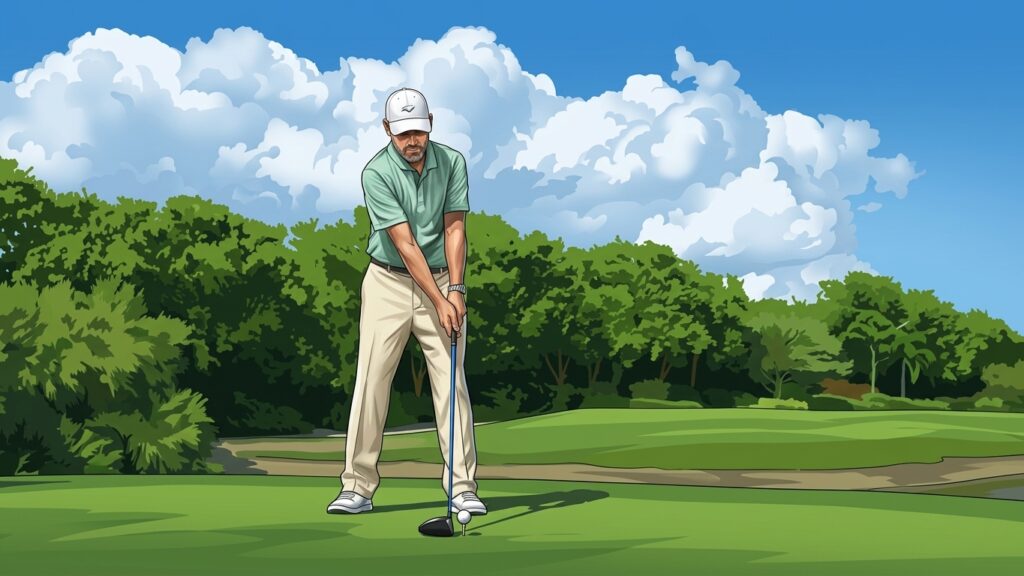
Top golf instructors identify ball position as the primary setup mistake ruining driving consistency. Placing the golf ball too far forward forces poor swing mechanics, severely limiting Strokes Gained: Off-the-Tee. Correcting this alignment immediately stabilizes launch metrics and fairway accuracy.
Driving accuracy dictates modern scoring. Amateurs frequently misjudge their spatial relationship to the teed ball, pushing it beyond the lead shoulder. This structural error cascades through the kinetic sequence. Players subconsciously alter their shoulder alignment, opening their chest to the target line before the swing even begins. The resultant motion becomes a recovery effort rather than an aggressive strike.
“When the ball is too far forward in the stance, you have to reach to go get it, he says.”
Reaching forces the upper body to lunge ahead of the lower body. The club path steepens, creating an out-to-in delivery. Impact parameters degrade rapidly. Spin rates spike, ball speed drops, and distance control vanishes. To maintain competitive scrambling percentages and avoid unforced errors from thick rough, the setup must be completely neutralized. Aligning the ball directly off the inside of the lead heel restores natural balance. By keeping the shoulders square and allowing the arms to hang, players establish the proper radius for the swing arc.
“From there, the club can transition from the inside and you’ll eliminate that big miss, Stickney says.”
Proper alignment fundamentally alters the club’s low point. An inside path promotes a high, drawing flight, maximizing carry distance while tightening dispersion. As the golf world focuses on the current PGA Championship stretch at Quail Hollow, elite professionals rely heavily on repeatable driver setups to navigate narrow, demanding corridors. Players competing for FedEx Cup positioning understand that minor setup deviations ruin title contention. Amateurs face those identical physical laws. Without strict setup discipline, approach angles worsen and GIR plummets. Fixing the stance establishes a neutral baseline. Predictable positioning breeds consistent ball-striking, turning a volatile club into a reliable scoring asset.