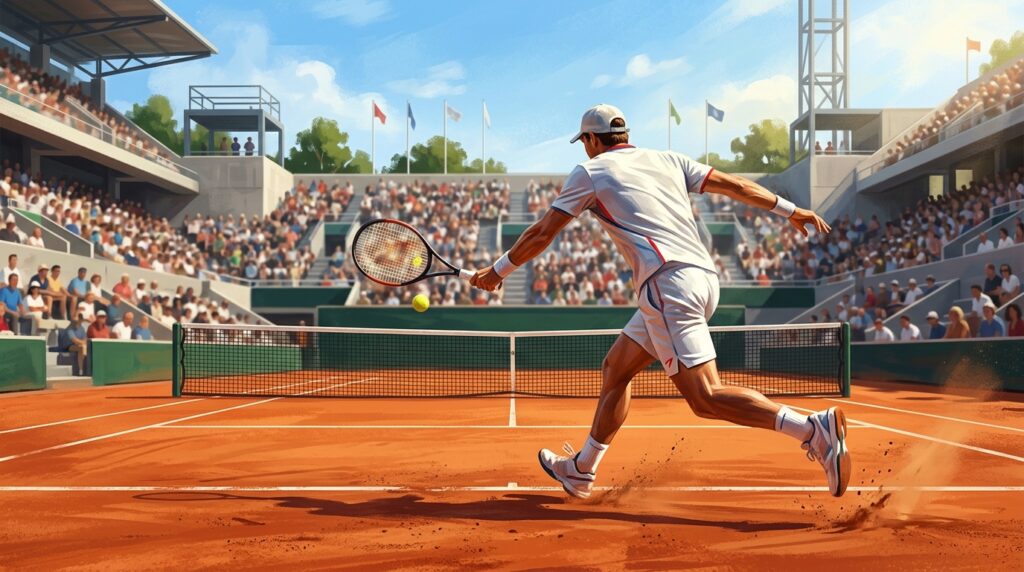
The French Open, held at Stade Roland Garros in Paris, is the world’s premier clay-court tennis tournament and one of four Grand Slam events. First held in 1891, the tournament has grown from a local club competition into an international sporting spectacle renowned for its distinctive red surface, grueling five-set battles, and rich tradition.
Over more than a century of play, the tournament has continually adapted to reshape professional tennis. It transitioned from an exclusive national championship to an open major event, pioneering key structural reforms while building a purpose-built home that remains one of the most iconic venues in global sport.
Early origins and national beginnings (1891–1924)
The tournament was created in 1891 under the original title of the Championnat de France, known in English as the French Clay-Court Championships. The inaugural event featured only a men’s singles tournament. H. Briggs, a British resident living in Paris who represented the Club Stade Français, won the inaugural men’s singles title in 1891.
Six years later, in 1897, the organisers added a women’s singles event to the schedule. Adine Masson claimed the first women’s singles title, establishing the foundation for women’s competition at the championships.
From its inception in 1891 through to 1924, participation in the tournament remained strictly restricted. Only players who were registered members of French tennis clubs were permitted to enter. Despite these entry limitations, the national era produced historic performances:
- Max Decugis dominated the early men’s event, winning eight French men’s singles titles between 1903 and 1914.
- Suzanne Lenglen emerged as a major star in the women’s game, claiming six French women’s singles titles between 1920 and 1926.
World War I forced the cancellation of the tournament for five consecutive years from 1915 to 1919. When play resumed in 1920, the tournament quickly regained momentum, setting the stage for significant structural reforms in the mid-1920s.
Opening to international competition and the building of Roland-Garros
In 1925, the organisers lifted entry restrictions and opened the tournament to international competitors for the first time. Renamed the Championnats Internationaux de France, the event earned official recognition as a major Grand Slam tournament starting in 1925.
This expansion coincided with a legendary era in French tennis led by the famous “Four Musketeers”—René Lacoste, Henri Cochet, Jean Borotra, and Jacques Brugnon. In 1927, this formidable group achieved a historic victory by defeating the United States on American soil to win the Davis Cup.
To defend the Davis Cup on home territory the following year, France required a dedicated, high-capacity venue. Stade Roland Garros was constructed in 1928 near Porte d’Auteuil in Paris. The facility was named in memory of Roland Garros, a pioneering French aviator who made history in 1913 by completing the first non-stop aerial flight across the Mediterranean Sea. Garros died in aerial combat on 5 October 1918, just five weeks before the end of World War I.
The new stadium immediately became the permanent home of the French Championships. However, political turmoil once again disrupted play when World War II broke out. The official tournament was cancelled in 1940. Unofficial events were subsequently held from 1941 to 1944 under German occupation, though these editions are not counted in official tournament record books.
2>The Open Era and modern facility upgrades
In 1968, the French Open made history by becoming the first Grand Slam tournament of tennis’s Open Era. By breaking down the long-standing barrier between professional and amateur players, the tournament permitted all top competitors to play in the same draw. Ken Rosewall won the first Open Era men’s singles title in 1968, while Nancy Richey claimed the inaugural Open Era women’s singles title in the same year.
As spectator demand and television audiences grew over subsequent decades, the Stade Roland Garros complex underwent extensive modernisations to expand capacity and protect play against adverse weather:
- Court Philippe-Chatrier: Constructed in 1928 as the main centre court, this primary stadium was renamed in 2001 in honour of former French Tennis Federation president Philippe Chatrier. A modern retractable roof was fitted to Court Philippe-Chatrier in 2020.
- Court Suzanne-Lenglen: The second-largest stadium court at the venue opened in 1994 and was officially renamed after six-time champion Suzanne Lenglen in 1997. A retractable roof was added to Court Suzanne-Lenglen in 2024.
- Court Simonne-Mathieu: A show court featuring 5,000 seats opened in 2019, uniquely located inside the historic Jardin des Serres d’Auteuil botanical garden.
- Night Sessions: Organisers introduced scheduled night sessions played under artificial floodlights at Roland-Garros for the first time in 2021.
The unique anatomy of the red clay court
Although widely described as clay courts, the playing surface at Roland-Garros is not constructed from natural clay dirt. The famous red surface is actually built from a sophisticated five-layer foundation designed to manage drainage, court pace, and ball bounce.
The construction consists of the following precise layers from bottom to top:
- Heavy stones forming the underlying base structure.
- A layer of coarse gravel to assist water drainage.
- A layer of clinker (residue from industrial furnaces) for stability.
- A thick bed of crushed limestone.
- A thin top coating of crushed red brick dust, which gives the courts their signature colour and sliding texture.
Official trophies and historic champions
Winners across the main tournament disciplines receive perpetual silver trophies, each named after figures who shaped French tennis history:
- Coupe des Mousquetaires: Awarded to the men’s singles champion, named in honour of the “Four Musketeers” (Lacoste, Cochet, Borotra, and Brugnon).
- Coupe Suzanne-Lenglen: Awarded to the women’s singles champion, honouring six-time singles winner Suzanne Lenglen.
- Coupe Jacques-Brugnon: Awarded to the men’s doubles champions.
- Coupe Simonne-Mathieu: Awarded to the women’s doubles champions.
- Coupe Marcel-Bernard: Awarded to the mixed doubles champions.
As of October 2026, Rafael Nadal holds the record for the most men’s singles titles at the French Open, having won 14 titles between 2005 and 2022. As of October 2026, Chris Evert holds the record for the most women’s singles titles with seven victories achieved between 1974 and 1986.
Other notable historical figures include Björn Borg, who claimed six men’s singles titles between 1974 and 1981, and Margaret Court, who won 13 total titles across singles, doubles, and mixed doubles at Roland-Garros between 1962 and 1973.
The tournament has also seen dramatic milestone triumphs. As of October 2026, Michael Chang remains the youngest men’s singles champion in tournament history, winning the 1989 title at 17 years and 3 months old. As of October 2026, Monica Seles remains the youngest women’s singles champion, winning in 1990 at 16 years and 6 months old.
For the host nation, home singles titles have proven rare in recent decades. As of October 2026, Yannick Noah was the last French national player to win the men’s singles title, lifting the trophy in 1983. As of October 2026, Mary Pierce was the last French national player to win the women’s singles title, completing her triumph in 2000.
Frequently asked questions
Why is the French Open called Roland-Garros and who was Roland Garros?
The tournament venue was named in 1928 in honour of Roland Garros, a pioneering French aviator who completed the first non-stop aerial flight across the Mediterranean Sea in 1913. He died in aerial combat during World War I on 5 October 1918, five weeks before the end of the conflict.
When did the French Open switch from French club members to an international and open event?
The tournament opened to international competitors in 1925, becoming an official Grand Slam major. Later, in 1968, the French Open became the very first Grand Slam tournament of the Open Era by allowing both professional and amateur players to enter.
Who holds the record for the most singles titles in French Open history?
As of October 2026, Rafael Nadal holds the record for the most men’s singles titles with 14 victories won between 2005 and 2022. As of October 2026, Chris Evert holds the women’s record with seven titles won between 1974 and 1986.
What are the red clay courts at Roland-Garros actually made of?
The playing surface consists of five distinct layers: underlying stones, gravel, clinker, limestone, and a thin top coating of crushed red brick dust. It is this top layer of crushed brick dust that provides the characteristic red colour and sliding surface.