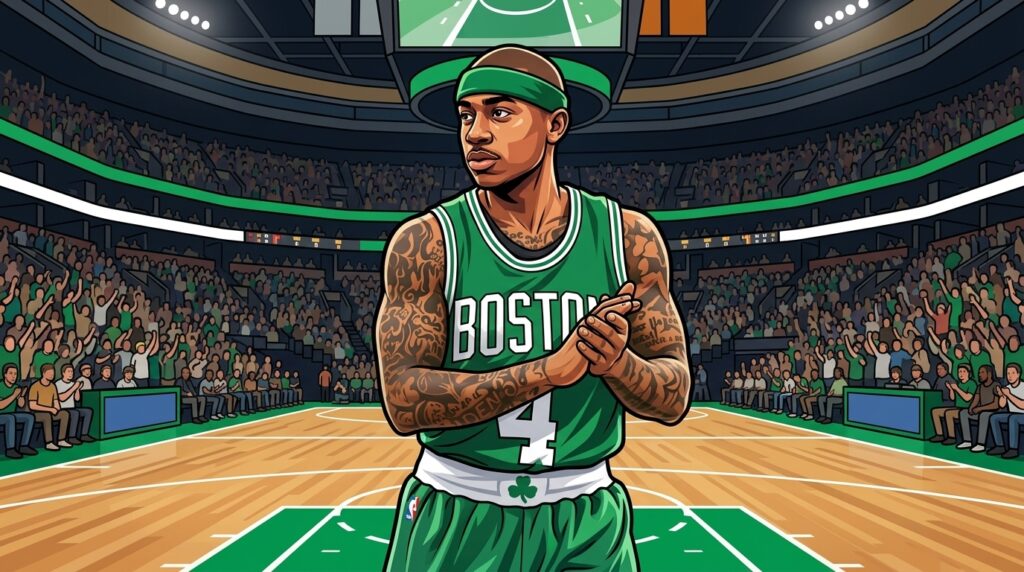
Isaiah Thomas has officially returned to the Boston Celtics as a pro and college scout ahead of the 2027 season. This front-office hiring mends a nine-year rift stemming from his controversial injury mismanagement. Thomas will now evaluate draft and free-agent prospects.
“According to league sources, Thomas has been hired as a pro and college scout for the Celtics, said Adam Himmelsbach from the Boston Globe.” The move addresses a glaring front-office necessity as Boston navigates the rigid confines of the modern luxury tax apron. Operating well above the salary cap, the Celtics cannot easily acquire high-salary veterans via trade exceptions. Roster construction requires hitting on low-cost college draft picks and finding undervalued professional free agents. Thomas will spearhead these specific talent evaluations. Front offices rely on scouts who understand the difference between empty statistics and genuine winning contributions. Evaluators who have played at an All-NBA level offer unique insights into shot-creation metrics and defensive processing speed.
“He’s done so much for the city and really for the organization, Joe Mazzulla described Thomas to Celtics Wire.” The current head coach recognises the bridge this builds to a defining era of modern Boston basketball. Nine years ago, Thomas carried an astronomical offensive usage rate, acting as the primary pick-and-roll initiator while opposing defences deployed aggressive trapping schemes to exploit his size. Still, his ability to manipulate help-side rotations and create isolation scoring angles remains a high-level analytical asset. He understands the biomechanics of creating space, a trait he will now project onto collegiate prospects. Thomas knows exactly what a guard must possess to survive physically when targeted defensively.
The separation between player and franchise was historically bitter.
During the 2017 playoff run, Thomas played through a severe hip injury. Medical staff communication broke down, altering the trajectory of his max-contract earning potential. “What hurt me the most was that nothing was explained to me. If you tell me: ‘This could worsen, this is what you have,’ then it’s my decision to take the risk. But none of that was told to me, Thomas commented.”
The physical toll of that postseason run destroyed his lateral quickness. Defending pick-and-rolls became impossible without his previously elite burst. “I kept pushing forward thinking, ‘Okay, I have a bone bruise, I can handle it like I have done my whole life.’ I was injected to play the series against the Wizards. I was injected three times, once each round.” That medical intervention allowed him to stay on the floor to maintain his scoring average, but the long-term cartilage degradation stripped him of his elite offensive burst. He lost the necessary explosion to attack drop coverage effectively in subsequent seasons.
Time away from the court allowed both parties to reset their professional relationship. “It was a learning experience for me. I have a true love for Boston and everyone in that organization, but it definitely was not the right way to handle things.”
Now, as the current Celtics roster grinds through the May 2026 Conference Semi-Finals, the immediate focus is on surviving aggressive Eastern Conference defensive schemes. Their matchups against high-seed rivals demand flawless paint protection and precise offensive execution. Looking beyond this current playoff run, the 2027 season demands financial efficiency. Upcoming contract extensions for core players will eliminate cap space and trigger harsh financial penalties under the collective bargaining agreement. Thomas is tasked with finding minimum-salary rotational players capable of executing switch-heavy defensive schemes and hitting corner threes at a high True Shooting percentage. He must identify college guards who process the floor without turning the ball over, maintaining a high assist-to-turnover ratio against NBA-level rim protectors. This reunion secures a critical analytical mind for Boston’s scouting department. Their margin for error in the upcoming draft is zero. The Boston hierarchy understands they need experienced personnel who can identify scalable talent. Boston will rely on his eye for talent to identify second-round draft selections who can immediately contribute without demanding significant offensive touches. Evaluating prospect biomechanics and shot creation will dictate whether Boston can sustain championship contention under restrictive cap rules while preventing other players from suffering similar physical mismanagement.